How to Fix Inconsistent AI Output When Writing Content
You run the same AI prompt twice. The first response is sharp and useful. The second is vague, off-topic, or formatted differently. This guide shows you exactly why AI content writing output varies and what you can do to make your results more predictable and reliable.
You sit down to draft a batch of blog posts using an AI writing tool. The first article comes out well-structured, with a clear angle and a natural tone. The second article on a similar topic reads like a generic listicle. The third one drifts into irrelevant territory entirely. You are using the same tool and roughly the same prompt, yet the results feel like they came from three different writers.
This is the problem of inconsistent AI output when writing content. It is one of the most common frustrations for content writers, bloggers, SEO professionals, and marketers who rely on AI-assisted workflows. The inconsistency is not random, and it is not entirely the AI's fault. In most cases, it is a symptom of missing structure, unclear context, or an overreliance on the model's default behavior.
This article explains why AI-generated content varies, what actually causes inconsistent output, and how to fix inconsistent AI output when writing content through better prompts, better workflows, and better quality controls. You will learn practical techniques you can apply immediately, regardless of whether you use ChatGPT, Claude, Gemini, or another AI writing tool. You will also learn when inconsistency is a sign that you are asking the AI to do something it is not well-suited for.
What Actually Causes Inconsistent AI Output When Writing Content?
Before you can fix inconsistent AI output when writing content, you need to understand why it happens. Large language models are probabilistic systems, not deterministic programs. When you provide a prompt, the model predicts the most likely next word or token based on patterns learned during training. This means the output can vary each time, even with the same prompt.
However, the variation is not purely random. It is heavily influenced by the quality and specificity of your prompt, the context you provide, the temperature setting of the model, and whether you give the AI enough constraints to work within. A vague prompt leaves too much room for the model to make different decisions each time. A highly structured prompt narrows that space dramatically.
Other factors also contribute to inconsistency. The AI's training data contains a massive range of writing styles, tones, and formats. Without clear direction, the model may draw from different parts of that data for different outputs. If you use a conversational tone in one prompt and a formal tone in another, the results will naturally differ. If you skip important context such as target audience, content goal, or brand voice, the AI fills those gaps in unpredictable ways.
Understanding this is the foundation. Inconsistent AI output is not a flaw you have to tolerate. It is a signal that your input needs more structure, your workflow needs more standardization, or your expectations need adjustment.
Why Does Consistent AI Content Writing Output Matter?
Consistency matters because content production is rarely a one-off task. If you are a blogger publishing three posts per week, a freelancer managing content for five clients, or an agency producing dozens of articles per month, you need predictable output. You need to know that when you run a content brief through your AI workflow, you will get a usable draft that matches your standards and your client's expectations.
Inconsistent output forces you to spend more time reviewing and rewriting. It makes quality control harder. It undermines trust in the AI-assisted workflow. If you cannot rely on the AI to produce a consistent starting point, you may find yourself abandoning the tool altogether, which wastes the efficiency gains you were hoping to achieve.
For SEO content specifically, consistency also affects how well your content performs. A well-structured article that follows a clear search intent, uses headings properly, and maintains a consistent tone is more likely to satisfy readers and search engines alike. If your AI produces wildly different structures and tones from one article to the next, your content strategy becomes harder to manage.
Core Principles for Consistent AI Content Generation
Fixing inconsistent AI output when writing content begins with a shift in how you think about prompts. A prompt is not a casual question. It is a specification. The more precise the specification, the more consistent the output. Here are the core principles that make the biggest difference.
- Define the role explicitly. Start every prompt with a clear role assignment. "You are a content writer specializing in B2B SaaS." This sets the frame and reduces ambiguity about what kind of language, tone, and depth the AI should use.
- Lock down the format. Tell the AI exactly what structure you want. "Use H2 headings for major sections and H3 for subsections. Start with an introduction that states the problem. End with a conclusion that summarizes the key takeaways." When the format is specified, the AI has fewer decisions to make on its own.
- Define the target audience. "Write for a small business owner who has basic SEO knowledge." This prevents the AI from swinging between beginner-friendly and expert-level content.
- Set tone and voice parameters. "Use a direct, professional tone. Avoid exclamation points. Do not use buzzwords." These constraints keep the output stylistically consistent.
- Provide a content model or reference example. If you have a previously approved piece of content, tell the AI to match its style and structure. "Write in the same tone and format as the sample provided."
Each of these principles reduces the degrees of freedom the AI has. The more you constrain the output, the more predictable it becomes. That does not mean the content will be boring or formulaic. It means the AI is working within a framework you control, which is exactly what you want for consistent content production.
How to Fix Inconsistent AI Output When Writing Content: A Practical Framework
Here is a five-step framework you can use to standardize your AI content writing workflow and dramatically reduce output variability. This is not a rigid checklist, but rather a repeatable process that produces consistent results across different topics and content types.
Step 1: Build a Master Content Prompt Template
Instead of writing a new prompt from scratch each time, create one master template that includes your role, audience, tone, format, and quality standards. This template stays the same for every piece of content. The only things that change are the specific topic, keywords, and unique context for each article.
For example, your master template might begin: "You are an SEO content writer. Your audience is small business owners who want practical marketing advice. Write in a direct, professional tone. Use short paragraphs and clear subheadings. Always include an introduction that identifies the reader's problem and a conclusion that provides actionable takeaways."
Step 2: Create a Detailed Content Brief for Each Topic
Before you prompt the AI, write a short content brief that covers the target keyword, search intent, the primary question the content must answer, the subtopics to include, and any specific examples or angles to use. This brief becomes part of the prompt and ensures the AI has enough context to stay on track.
A good content brief for AI writing includes: the working title, the primary keyword, the search intent (informational, commercial, transactional, navigational), the target word count, the key subtopics, the internal links to include, and any brand-specific details such as product names or tone preferences.
Step 3: Specify the Output Format Precisely
Do not leave the structure to the AI. Tell it exactly what you want. For a blog post, specify that you want an H1 title, an introduction paragraph, three to four H2 sections, and a conclusion. For a product description, specify the word count, the features to highlight, and the tone to use.
The more specific you are, the less variability you will see. If you want the output in markdown, say so. If you want bullet points inside the body, specify that. If you want a specific heading hierarchy, define it.
Step 4: Add Constraints and Quality Checks
Include explicit instructions about what the AI should avoid. For example: "Do not use the phrase 'in today's digital age.' Do not write more than 150 words in the introduction. Do not use rhetorical questions. Do not include statistics unless they are from a verifiable source." These negative constraints are as important as the positive ones.
Also include a self-check instruction. "Before returning the output, review it for consistency with the brief. Flag any sections that do not address the target audience or search intent." This encourages the AI to self-correct before delivering the result.
Step 5: Review, Refine, and Save Your Best Prompts
After you run the prompt, review the output critically. Identify what worked and what did not. Refine the prompt accordingly and run it again. Once you have a prompt that produces consistently good results, save it. Over time, you will build a library of reliable prompts for different content types and topics.
This is where a structured resource can accelerate your progress. Instead of building every prompt from zero, you can use a ready-made collection of tested prompts. For example, Ahmad Market's 35 Premium SEO Prompts includes templates for a variety of SEO content tasks. If your focus is specifically on content optimization, the SEO Content Optimization Prompts pack provides targeted prompts for improving content quality and consistency.
Practical Examples: Fixing Inconsistent AI Output in Real Situations
The following examples show how the same task can produce wildly different results depending on how you structure the prompt. These are hypothetical but realistic scenarios based on common content writing workflows.
Blog Post for an E-commerce Site
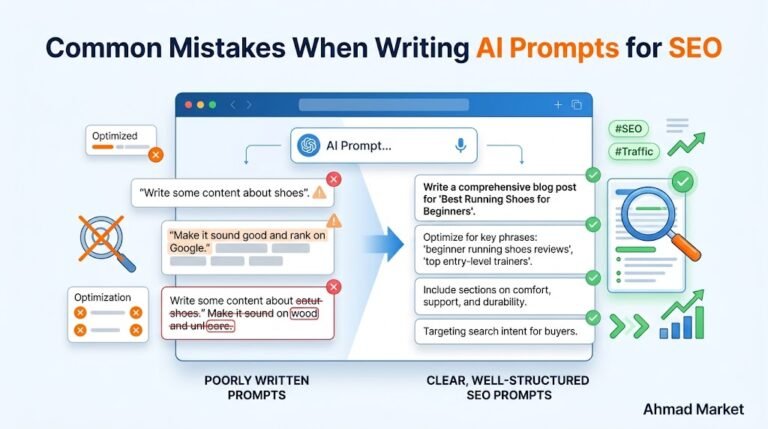
Inconsistent prompt: "Write a blog post about organic dog food."
This prompt gives the AI no context, no audience, no format, and no tone. Each time you run it, the AI may produce a different angle, tone, length, and structure. One run may produce a formal academic essay. Another may produce a casual lifestyle post.
Consistent prompt:
Email Newsletter for a SaaS Company
Inconsistent prompt: "Write an email about our new feature."
This prompt produces unpredictable results because it does not specify the feature, the audience, the tone, or the call to action. The AI may write a formal product announcement or a casual chatty message, depending on how it interprets the task.
Consistent prompt:
Product Description for an Online Store
Inconsistent prompt: "Describe this candle."
Without context about the brand, the product's unique features, the target customer, or the desired tone, the AI will produce a different description every time. One output might be poetic and abstract. Another might be a dry list of ingredients.
Consistent prompt:
Common Mistakes That Keep AI Content Output Inconsistent
Even experienced writers fall into predictable traps when working with AI content tools. Recognizing these mistakes is the fastest way to improve consistency.
- Using the same prompt for different content types. A prompt that works for a blog post will not work for a product description or an email. Each content type has its own structure, tone, and purpose. Your prompts need to reflect those differences.
- Skipping the target audience. When the AI does not know who it is writing for, it defaults to a generic tone. This leads to output that feels inconsistent from one piece to the next because the AI is essentially guessing each time.
- Not specifying the output format. Leaving structure to the AI is a recipe for inconsistency. Specify headings, paragraph length, bullet usage, and overall organization.
- Changing prompts between runs. If you tweak the prompt each time, you are not comparing apples to apples. The output varies because the input varies. Keep the master prompt stable and only change the topic-specific details.
- Ignoring the temperature setting. Many AI platforms allow you to adjust the temperature, which controls how creative or random the output is. A high temperature produces more varied results. A low temperature produces more focused, predictable output. If you want consistency, use a lower temperature setting.
- Trusting the output without a human review. Even with a strong prompt, AI output needs to be checked. Inconsistency is not just a structural problem. It can also affect factual accuracy, brand voice, and strategic alignment. Always review before publishing.
- Not saving prompts that work. If you produce a great piece of content and then cannot remember the prompt you used, you lose the opportunity to replicate that success. Save every prompt that produces good results.
Best Practices for a Reliable AI Content Writing Workflow
Consistency is not just about individual prompts. It is about the workflow you build around those prompts. The following practices help you create a system that produces reliable output every time.
Standardize your prompt library. Create a collection of master prompts for each content type you produce regularly: blog posts, product descriptions, email newsletters, social media captions, meta descriptions, and content briefs. Each master prompt should include your role, audience, tone, format, and quality constraints. When you need to produce a new piece, you copy the relevant master prompt and fill in the topic-specific details.
Use a content brief as an input layer. Before you prompt the AI, spend five minutes writing a brief that covers the target keyword, search intent, primary question, subtopics, and any brand-specific details. This brief becomes part of the prompt and ensures the AI has the context it needs to stay on track.
Set a consistent review process. After the AI generates a draft, review it against your brief. Check the structure, tone, factual claims, and alignment with search intent. If the output is inconsistent, adjust the prompt and run it again. Over time, you will learn which adjustments produce the best results.
Document your voice and style guide. If you have a brand voice guide, include it in your prompts. If you do not have one, create a simple version: two or three adjectives that describe your tone, any words or phrases to avoid, and the level of formality you prefer. This small step dramatically improves consistency.
Use templates for recurring content. For blog posts that follow a similar structure, create a template that defines the sections, approximate word counts, and transition phrases. Feed this template into your prompt so the AI follows the same skeleton every time.
When Is Inconsistent AI Output a Sign You Are Using the Wrong Tool?
Sometimes the problem is not your prompt. It is the task itself. AI writing tools are excellent at generating drafts, brainstorming ideas, and structuring content. They are less reliable for tasks that require real-time data, subjective judgment, or domain-specific expertise.
For example, if you ask an AI to write a detailed technical article about a complex regulatory topic, the output may vary significantly because the model is drawing from a wide range of sources with different levels of accuracy and relevance. In this case, inconsistency is a signal that you should use the AI for the structure and outline, but write the technical sections yourself or work with a subject matter expert.
Similarly, if you ask an AI to write content that requires a highly specific brand voice—such as a quirky, irreverent tone for a consumer brand—the AI may struggle to replicate that voice consistently without extensive examples and constraints. In these cases, providing three or more reference examples in the prompt can help, but human editing is often still necessary.
The key is to recognize when inconsistency is a prompt problem and when it is a tool limitation. If you have refined your prompt, added context, specified the format, and adjusted the temperature, yet the output still varies significantly, you may be asking the AI to do something it cannot do reliably. Use it for the parts it does well and handle the rest yourself.
How to Turn Consistent Prompts Into a Repeatable Content System
Once you have a few prompts that produce consistent, high-quality output, do not let them disappear into a chat history. Save them in a document or spreadsheet. Organize them by content type and use case. Refine them over time as you learn what works and what does not.
Many content writers and SEO professionals find that investing in a structured prompt pack accelerates this process. Instead of starting from a blank page, you start from a proven template and adapt it to your specific project. This is especially useful when you are producing content at scale or training a team member on your workflow.
If you want a ready-made starting point, Ahmad Market's 35 Premium SEO Prompts provides a structured collection of prompts covering keyword research, content optimization, technical audits, and more. For content-focused workflows specifically, the SEO Content Optimization Prompts pack offers templates designed to improve content quality, structure, and search intent alignment.
Keep in mind that any prompt pack is a starting point, not a finished solution. You will still need to adapt the prompts to each client's specific situation, verify the output, and apply your own professional judgment. But starting from a structured template is far more efficient than starting from nothing, and it gives you a baseline for consistency that is hard to achieve when you are improvising every prompt from scratch.
For a deeper understanding of how to write better prompts in general, the guide on good AI prompts for content writing offers practical examples and frameworks that complement the strategies in this article. If you are struggling with recurring prompt mistakes, the article on common AI prompt mistakes can help you identify and fix the specific issues that lead to inconsistent output.
What Consistent AI Prompts Cannot Fix
Even the most carefully crafted prompt has limitations. Being honest about what consistent AI content generation cannot do will help you set realistic expectations and avoid embarrassing mistakes in published content.
- AI prompts cannot fix factual errors. A consistent prompt will produce consistent structure and tone, but it will not guarantee factual accuracy. If the AI includes a statistic or a claim, you must verify it independently before publishing.
- AI prompts cannot replicate your unique brand voice perfectly. You can get close by providing examples and constraints, but there will always be nuances that only a human writer can capture. Plan for a human edit pass.
- AI prompts cannot guarantee that content will rank well. Consistency helps you produce better content, but search rankings depend on many factors beyond your content, including competition, backlinks, and user behavior. No prompt can guarantee Google rankings.
- AI prompts cannot replace strategic content judgment. The AI does not know your business goals, your competitive landscape, or your audience's evolving needs. It can execute a brief, but it cannot create the brief for you. That strategic work is still yours.
- AI prompts cannot eliminate the need for human review. Even with a consistent workflow, you should always review AI-generated content before using it. The review step is where you catch errors, improve flow, and add the unique perspective that makes your content stand out.
Consistency is a tool, not a guarantee. Use it to reduce variability and save time, but do not expect AI output to be publication-ready without human involvement.
Frequently Asked Questions
Why does my AI produce different results with the same prompt?
Large language models are probabilistic systems. They predict the next word based on patterns, which means even identical prompts can produce slightly different outputs. The variation increases when the prompt is vague or lacks specific context. Adding more structure, constraints, and format instructions reduces this variability significantly.
How can I make my AI content output more consistent without rewriting every prompt?
Create a master prompt template that includes your role, target audience, tone, format, and quality constraints. Use this template as the foundation for every content prompt. Only change the topic-specific details such as the keyword, subtopics, and target word count. This keeps the input consistent and reduces output variability.
What is the best temperature setting for consistent AI content writing?
A lower temperature setting (usually between 0.2 and 0.5) produces more focused, predictable output. Higher temperatures (0.8 and above) introduce more creativity and variability. For content that needs to be consistent in tone, structure, and style, a lower temperature is generally better. Check whether your AI platform allows temperature adjustment.
Should I include examples in my AI content prompts?
Yes, whenever possible. Providing one or two examples of the style, tone, or structure you want can dramatically improve consistency. The AI can pattern-match against your example and produce output that aligns more closely with your expectations. Examples are especially helpful when you have a specific brand voice or content format.
How do I know if the inconsistency is a prompt problem or a tool problem?
If you have refined your prompt with clear role, context, format, and constraints, and the output still varies significantly across multiple runs, the task may be outside the AI's reliable capability. Tasks that require real-time data, precise factual accuracy, or a highly specific brand voice are more prone to inconsistency. In these cases, use AI for structure and outlines, and handle the details yourself.
What to Remember About Fixing Inconsistent AI Output When Writing Content
Inconsistent AI output when writing content is a real frustration, but it is not an unsolvable problem. The root cause in most cases is not the AI model itself, but the lack of structure, context, and constraints in your prompts. When you give the AI a clear role, a defined audience, a specific format, and explicit quality standards, you dramatically reduce the variability in the output.
The five-step framework in this article—building a master prompt template, creating detailed content briefs, specifying output format, adding constraints, and saving your best prompts—provides a practical path toward more consistent AI-assisted content production. Combined with a disciplined human review process, this approach can help you use AI more effectively without sacrificing quality or control.
Remember that consistency is a means to an end, not the end itself. The goal is to produce useful, accurate, engaging content that serves your readers and supports your SEO strategy. AI can help you get there faster, but it works best when you treat it as a tool within a larger content workflow—not as a replacement for human judgment.
If you want a structured starting point to avoid rebuilding prompts from scratch, explore the SEO prompt resources available at Ahmad Market. The right set of templates can save you time and help you establish a consistent baseline for every piece of content you produce.
Your next practical step is simple. Take one recurring content task you perform regularly. Write a master prompt using the framework from this article. Test it. Refine it. Save it. That single prompt will improve consistency across every future piece you produce.