How to Structure a Prompt for a Website SEO Audit
A well-structured SEO audit prompt saves hours of manual analysis and produces consistent, actionable results. This guide breaks down the exact structure, practical examples, and common mistakes to avoid when building audit prompts for AI tools.
You paste a URL into ChatGPT and ask it to "do an SEO audit." The output is a generic list of suggestions—improve your meta tags, add more content, get more backlinks. None of it is specific. None of it tells you what to fix first or why it matters. You walk away feeling like the AI gave you a textbook definition instead of an audit.
The problem is not the AI model. The problem is the prompt. When you ask a vague question, you get a vague answer. But when you structure your prompt with the right context, scope, format, and quality constraints, the output shifts from general advice to a practical, prioritized checklist you can actually use.
This article explains how to structure a prompt for a website SEO audit. You will learn what makes an audit prompt effective, how to build prompts for different types of audits, the common mistakes that weaken your results, and how to turn your best prompts into a repeatable workflow. Whether you are a freelance SEO consultant, an agency serving multiple clients, or a website owner performing your own audits, these principles apply directly.
If you are new to using AI for SEO work, you may want to review our guide on effective AI prompts for SEO before diving into audit-specific structures.
What Is a Website SEO Audit Prompt?
A website SEO audit prompt is a structured instruction you give to an AI model—such as ChatGPT, Claude, or Gemini—to analyze a webpage or website and identify SEO issues, opportunities, and recommended fixes. The prompt can target technical SEO elements, on-page factors, content quality, internal linking, or a combination of all of these.
An SEO audit prompt is not the same as a general question like "How is my SEO?" A proper audit prompt includes specific instructions about what to examine, what information to use, what format to return, and what quality standards to apply. Without that structure, the AI defaults to generic advice that is rarely actionable.
The value of a structured audit prompt comes from its ability to standardize analysis. Instead of relying on memory or intuition, you give the AI a consistent framework. That framework ensures you check the same elements every time—title tags, meta descriptions, heading hierarchy, content depth, internal links, crawlability indicators—regardless of which client or website you are auditing.
Why Does Prompt Structure Matter for SEO Audits?
SEO audits involve many moving parts. A typical audit examines title tags, meta descriptions, heading structure, content relevance, internal linking, image optimization, page speed indicators, and crawlability. If you ask an AI to "check everything," it will either miss critical elements or return a shallow overview that covers everything but goes deep on nothing.
A structured prompt solves this problem by forcing you to think about what you actually need from the audit. Do you need a technical crawlability check? An on-page content analysis? A full-site content gap review? Each type of audit requires different inputs, different evaluation criteria, and a different output format.
Structure also improves consistency. When you work with multiple clients, you need your audits to be comparable. A standardized prompt structure ensures you evaluate the same elements in the same way every time. That consistency makes it easier to spot patterns, track improvements, and build trust with clients who expect thorough, professional deliverables.
Finally, structure forces clarity. The process of writing a well-structured prompt requires you to define the audit scope, the specific elements to examine, and the format you want back. That clarity improves the AI's output because it removes ambiguity. The AI knows exactly what to look for and how to present the findings.
Core Elements of an Effective SEO Audit Prompt
Every effective SEO audit prompt shares a common structure. You do not need to include every element every time, but covering the following components will significantly improve the quality and usefulness of your audit results.
- Role. Tell the AI what perspective to adopt. "You are a senior technical SEO auditor" produces different output than "You are a content SEO specialist." The role frames how the AI prioritizes and communicates findings.
- Audit scope. Define exactly what the audit covers. Are you examining technical crawlability, on-page elements, content quality, internal linking, or a combination? Specify the scope so the AI does not default to a generic overview.
- Input data. Provide the information the AI needs. This may include the URL, title tag, meta description, H1 tag, visible content, internal link structure, or a page's HTML. The more relevant data you provide, the more specific the audit becomes.
- Evaluation criteria. Explain what you want the AI to check for each element. For title tags, specify length, keyword placement, and uniqueness. For content, specify relevance, depth, and search intent alignment.
- Output format. Request a specific format—a numbered checklist, a table with severity ratings, or a prioritized list with recommendations. This makes the output easy to act on.
- Quality constraints. Tell the AI what good looks like. "Prioritize high-impact issues over minor formatting tweaks" or "Flag any recommendation that requires technical implementation resources."
When one of these elements is missing from your prompt, the output suffers. A missing scope creates generic advice. Missing input data forces the AI to make assumptions. Missing output format produces a wall of text that is hard to use. Review your prompt whenever the results feel off—the gap is usually in one of these six elements.
How to Structure a Prompt for a Website SEO Audit: Step-by-Step
Here is a five-step process for building effective SEO audit prompts. Follow this sequence deliberately for the first few audits. After a few iterations, the structure becomes intuitive and you will write strong prompts without thinking about each step.
Step 1: Define the Audit Type and Scope
Start by deciding what kind of audit you need. A technical SEO audit focuses on crawlability, indexing, and site architecture. An on-page audit examines meta tags, headings, content structure, and internal linking. A content audit evaluates relevance, quality, and search intent alignment. A full-site audit combines all three but requires more data and a longer output.
Write down the specific elements you want examined. For a technical audit, that may include canonical tags, robots directives, redirect chains, and structured data. For an on-page audit, the list may include title tag length, meta description presence, H1 uniqueness, and keyword placement in headings. Being explicit about scope prevents the AI from drifting into irrelevant analysis.
Step 2: Gather and Prepare Input Data
The AI can only analyze what you provide. For a single-page audit, that means the URL, title tag, meta description, H1 tag, visible content, and any relevant internal linking information. For a sitewide audit, you may need a list of URLs with their on-page elements extracted. If you have access to crawl data, include it—but be aware that the AI may not process large datasets effectively.
When gathering input data, organize it clearly. Label each field so the AI knows what it is looking at. "Title Tag:" followed by the actual title tag, "Meta Description:" followed by the meta description, and so on. This structure prevents confusion and ensures the AI evaluates the right information.
Step 3: Specify the Evaluation Criteria
Tell the AI what to check for each element. For title tags, the criteria may include length (typically 50–60 characters), keyword presence, brand inclusion, and uniqueness. For meta descriptions, the criteria may include length, call-to-action presence, and relevance to the page content. The more specific your criteria, the more actionable the recommendations become.
If you want the AI to flag issues by severity, specify the severity scale. For example: "Critical—blocks indexing or renders the page inaccessible; High—significantly impacts rankings or user experience; Medium—improves quality but is not urgent; Low—minor polish." This prioritization helps you focus on what matters first.
Step 4: Request a Specific Output Format
Decide how you want the results presented. A numbered checklist works well for action-oriented audits. A table with columns for "Element," "Issue Found," "Why It Matters," and "Recommended Fix" is ideal for client deliverables. A severity-ranked list is better for internal prioritization.
Be explicit about the format. Do not say "give me the results." Say "Return the findings in a table with the following columns: Element, Current State, Issue, Recommended Fix, and Priority Level (Critical, High, Medium, Low)." This level of specificity removes guesswork and ensures the output is immediately usable.
Step 5: Review, Refine, and Document
Run the prompt and review the output critically. Are the findings accurate? Are the recommendations realistic? Are there important elements the AI missed? Use your review to refine the prompt—add missing criteria, adjust the scope, or clarify the format.
Once you have a prompt that produces consistently strong results, document it. Save it in a prompt library or template file. The next time you need to audit a similar website, you can start from the refined version instead of building from scratch. This is how your prompt workflows become more efficient over time.
Practical Examples of Structured SEO Audit Prompts
The following examples show the difference between a weak audit prompt and a well-structured one for three common SEO audit scenarios. These are hypothetical examples designed to illustrate the principles covered in this article.
Single-Page On-Page SEO Audit
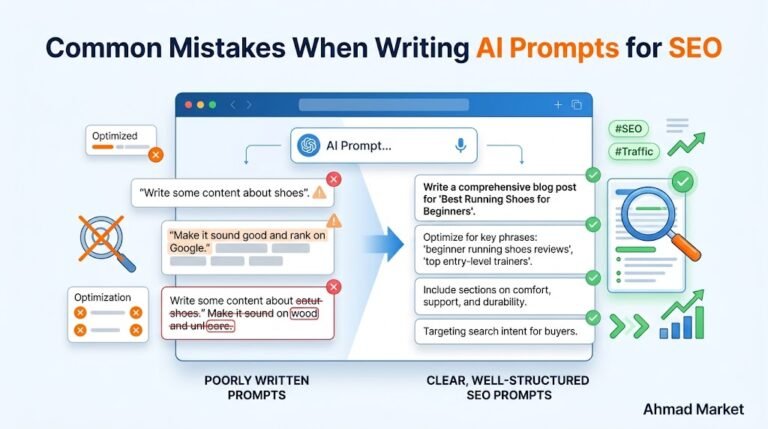
Weak prompt: "Check this page for SEO issues."
Strong prompt:
Technical SEO Audit Prompt
Weak prompt: "Are there any technical SEO problems on this site?"
Strong prompt:
Full Website SEO Audit Prompt
Weak prompt: "Audit my website for SEO."
Strong prompt:
Common Mistakes That Weaken SEO Audit Prompts
Even experienced SEO professionals fall into predictable traps when writing audit prompts. Recognizing these mistakes is the fastest way to improve the quality and usefulness of your AI-assisted audits.
- Failing to define the audit scope. Asking the AI to "audit my website" without specifying what to examine produces a generic overview that covers everything but goes deep on nothing. Always state whether the audit focuses on technical, on-page, content, or a defined combination.
- Providing insufficient input data. The AI cannot analyze what you do not give it. If you ask for a title tag audit but only provide the URL, the AI will guess based on limited information. Always include the actual on-page elements you want evaluated.
- Ignoring the target search intent. An audit that does not consider what the page is trying to rank for misses the point. Specify the target keyword and intended search intent so the AI can evaluate whether the content actually satisfies it.
- Accepting AI output without verification. AI tools can produce plausible-sounding but incorrect recommendations. Always verify technical claims, check that recommendations align with current SEO best practices, and use your own judgment before presenting findings to a client.
- Using the same audit prompt for every situation. A local service page has different audit needs than an e-commerce product page or a B2B landing page. Adapt the scope, criteria, and context for each audit type.
- Stopping after the first output. The first result is rarely the best result. Review what the AI produced, identify what is missing or inaccurate, refine the prompt, and run it again. Iteration is part of the process.
Best Practices for Building Repeatable SEO Audit Prompt Workflows
Once you understand how to structure an individual audit prompt, the next step is to build a repeatable system. Freelancers and agencies that standardize their audit prompts save time, produce more consistent deliverables, and reduce the mental overhead of starting from scratch every time.
One practical approach is to create a prompt template library organized by audit type. Write one master prompt for single-page on-page audits, another for technical crawlability checks, another for content quality reviews, and another for full-site overviews. Each template includes placeholder fields for client-specific details—URLs, target keywords, audience information, and unique constraints.
When you start a new audit, you fill in the placeholders rather than rebuilding the prompt from zero. This approach ensures consistency across clients while still allowing you to adapt the prompt to each specific situation. It also makes it easier to train team members on your audit methodology.
This is where a structured prompt resource can save significant time. Instead of building every audit prompt from scratch, you can start from a ready-made collection of SEO audit prompt templates. For example, Ahmad Market's Website SEO Audit Prompts pack provides a structured starting point for common audit workflows. Similarly, if your audits often involve technical elements, the Technical SEO Prompts pack can help you standardize those specific checks without reinventing the framework each time.
The goal is not to remove your professional judgment from the audit process. It is to remove the repetitive setup work so you can focus on analysis, interpretation, and strategic recommendations—the parts of an audit that genuinely require human expertise.
When Should You Use AI for SEO Audits — and When Should You Avoid It?
AI-assisted SEO audits are excellent for analyzing provided data, identifying patterns, and generating structured recommendations. They are less effective for tasks that require real-time crawl data, proprietary tool access, or nuanced judgment based on years of hands-on experience.
Use AI audit prompts for: analyzing on-page elements you have extracted, reviewing title tag and meta description quality, evaluating content structure against a target keyword, identifying internal linking gaps from a provided URL list, and generating prioritized checklists based on clear evaluation criteria.
Avoid relying on AI audit prompts for: real-time crawl data (the AI cannot crawl a website unless it has browsing access and you direct it to specific pages), accurate page speed measurements, backlink analysis, rank tracking, or any conclusion that requires data the AI does not have. Also avoid presenting AI-generated audit findings as fact without independent verification.
The most effective approach combines AI-generated structure with human verification. Let the AI organize the analysis and produce a structured draft. You provide the strategic interpretation, verify the technical accuracy, and prioritize recommendations based on business context. This hybrid workflow captures the efficiency of AI while maintaining professional quality.
Turning Your Audit Prompt Structure Into a Reusable System
Once you have written a few effective audit prompts, do not let them disappear into a chat history. Save them. Organize them by audit type. Refine them over time based on the quality of the output they produce. The prompt you wrote for one client's on-page audit can almost always be adapted for another client with minor changes to context, target keywords, and specific evaluation criteria.
Many SEO professionals find that investing in a structured prompt pack accelerates this process significantly. Instead of starting from a blank page, you start from a proven template and adapt it to the specific audit at hand. This is especially useful when you are onboarding new clients, standardizing deliverables across a team, or training junior SEO staff on your audit methodology.
If you want a ready-made starting point for your audit workflows, Ahmad Market's Website SEO Audit Prompts provides a structured collection specifically designed for audit tasks. For broader SEO prompt needs beyond audits, the 35 Premium SEO Prompts pack covers keyword research, content optimization, and client management workflows in addition to audits.
Remember that any prompt pack or template is a starting point, not a finished solution. You will still need to adapt the prompts to each specific website, verify the output against current best practices, and apply your own professional judgment to the findings. But starting from a structured template is far more efficient than starting from nothing, especially when you perform audits regularly.
What AI Audit Prompts Cannot Do
Even the best-structured audit prompt has limitations. Being clear about what AI cannot do will help you use it more wisely and avoid embarrassing mistakes in client work.
- AI prompts cannot crawl a website on their own. Unless the model has browsing capability and you explicitly direct it to access specific URLs, the AI is analyzing only the data you provide. It cannot independently discover pages, follow internal links, or check for crawl errors.
- AI prompts cannot access real-time search data. Search volume, keyword difficulty, ranking positions, and backlink data require tools like Ahrefs, Semrush, or Google Search Console. The AI may guess at these metrics, but those guesses are unreliable and should never be presented as factual data.
- AI prompts cannot verify their own recommendations. The AI may suggest SEO fixes that are outdated, technically incorrect, or inappropriate for the specific platform. Always verify recommendations against current Google documentation and your own professional knowledge before implementing or presenting them.
- AI prompts cannot replace professional SEO judgment. An audit prompt can generate a structured checklist, but it cannot tell you which issues matter most for this specific business, whether a recommendation fits the client's budget, or how to communicate findings diplomatically. Those decisions require human expertise.
Understanding these limitations keeps your expectations realistic. AI audit prompts are a productivity multiplier—not a replacement for the skills, tools, and experience that make an SEO professional valuable.
Frequently Asked Questions
Can I use ChatGPT to perform a full website SEO audit?
You can use ChatGPT or similar AI tools to analyze the data you provide and generate structured audit findings. However, the AI cannot independently crawl your website unless it has browsing access and you direct it to specific URLs. For a comprehensive audit, you still need to gather on-page data from your website or use an SEO tool alongside the AI analysis.
What information should I include in an SEO audit prompt?
Include the audit type and scope, the URL or URLs being analyzed, the on-page elements you want evaluated (title tags, meta descriptions, H1 tags, content, etc.), the target keywords and search intent if relevant, the evaluation criteria for each element, and the format you want the results in. The more specific you are, the more actionable the output becomes.
How long should my SEO audit prompt be?
There is no fixed length. A good audit prompt is as long as necessary to communicate the audit scope, evaluation criteria, and output format clearly. Some audit prompts are a paragraph. Others are several paragraphs with detailed criteria. The key is that every sentence adds necessary information. If you can remove a sentence without losing clarity, remove it.
Do I need technical SEO knowledge to use audit prompts effectively?
You need enough knowledge to define the audit scope, understand what the AI is evaluating, and verify the accuracy of the output. The AI can explain technical concepts, but you must be able to judge whether its recommendations are correct and appropriate for the specific website. Without basic SEO knowledge, you may accept inaccurate recommendations without noticing.
Can I use the same SEO audit prompt for every website?
You can use the same prompt structure or template, but the context and specific inputs must change for each website. An e-commerce product page audit requires different evaluation criteria than a local service business homepage audit. Standardize the framework, customize the details—the target keywords, audience, site type, and unique constraints.
Key Takeaways for Structuring SEO Audit Prompts
Structuring a prompt for a website SEO audit is a skill you can learn and improve. The core principle is straightforward: give the AI enough context, scope, evaluation criteria, and format requirements to produce output you can actually act on. The more specific you are about what to examine and how to present the findings, the more valuable the audit becomes.
Start by defining the audit type and scope. Gather the input data the AI needs. Specify the evaluation criteria for each element. Request a clear output format. Review the results, refine the prompt, and document what works. That process, repeated consistently, will transform how you approach SEO audits.
If you want a structured starting point instead of building every audit prompt from scratch, explore the Website SEO Audit Prompts available at Ahmad Market. The right template can save you hours of setup time and help you produce more consistent, professional audit deliverables for every client.
Your next step is practical. Take one audit task you perform regularly—a single-page on-page review, a technical crawlability check, or a content relevance evaluation. Write a strong prompt for it using the framework in this article. Test it. Refine it. Save it. That single prompt will pay for itself every time you use it.




One Comment